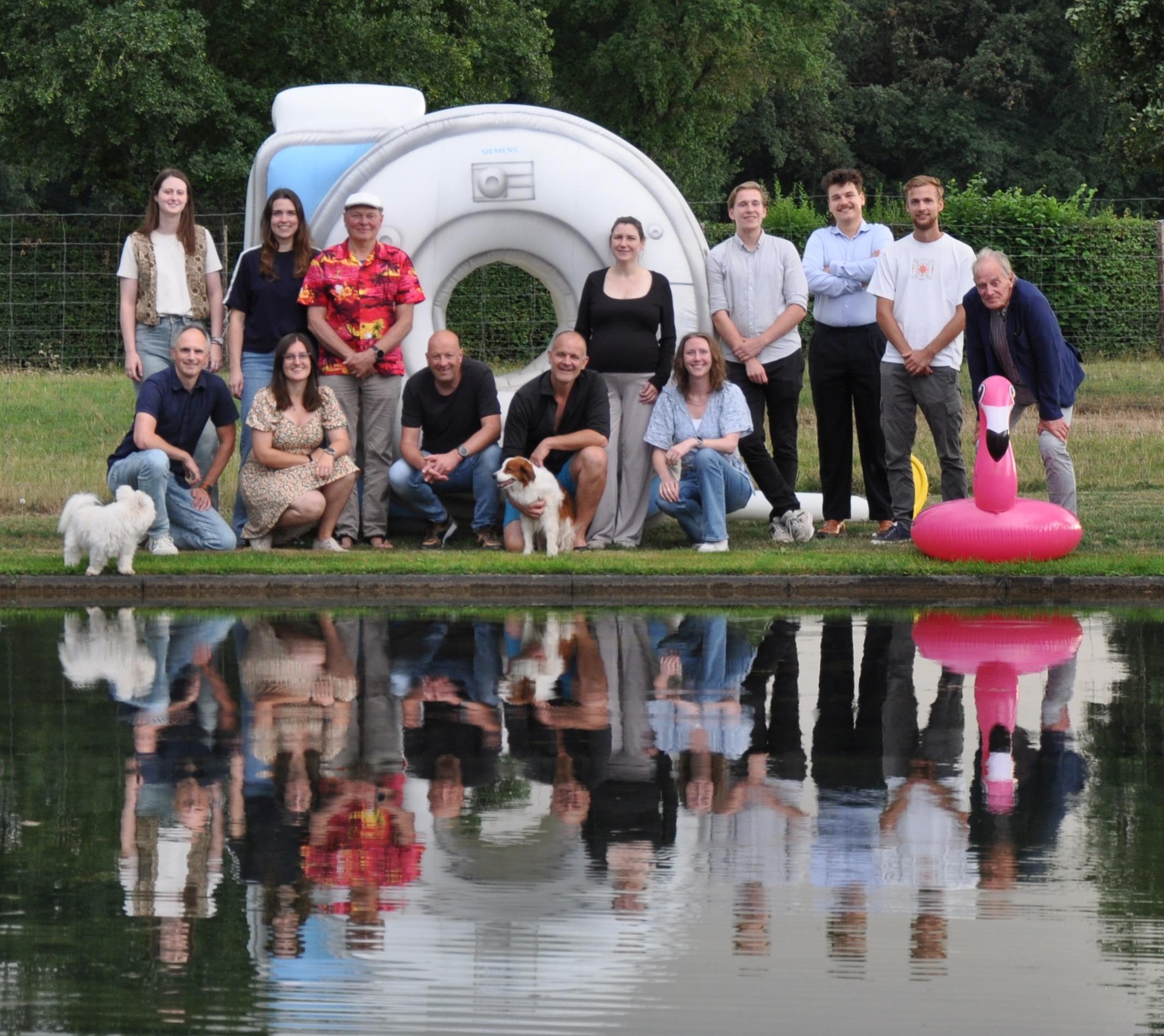
The Biomedical MR research group is one of the research groups at the department of Medical Imaging of the Radboudumc University hospital connected to Radboud University (RU). The aim of this group is to exploit the exquisite capabilities of MR in “molecular” and “biological” imaging to address biomedical questions and challenges.
Our research vision is to push magnetic resonance imaging and spectroscopy beyond its current physical and clinical limits, using ultra-high-field and multi-nuclear technologies to answer questions that are currently inaccessible in vivo. We focus on innovations in oncology that address urgent clinical needs such as early metastasis detection, motion-robust imaging, and quantitative therapy monitoring, while maintaining rigorous technical precision. MRI platforms such as 7T and the new 14T MRI are instruments to deepen biological understanding and improve patient care. We aim for transformative imaging research by integrating physics, engineering, AI, and clinical science within a high-trust team environment.
Our main research questions are:
- How can ultra-high-field MR reveal microstructural, functional, and metabolic biomarkers of early disease or disease progression that are invisible at conventional field strengths?
- How can biologically targeted or functional MRI (e.g., iron-based contrast, multi-nuclear approaches) outperform or complement molecular imaging in guiding personalized treatments?
- How can quantitative, motion-robust MRI be translated into validated, decision-support biomarkers for therapy selection and response monitoring?
- How can pre-clinical research fundamentally contribute to clinical translation of MR methodology and mechanistic knowledge?
Within the Radboudumc Prostate, Bladder, and Kidney Cancer program, our aim is to strengthen oncologic decision-making through advanced MRI. We develop and implement ultra-high-field (7T) and contrast-enhanced methodologies (e.g., USPIO) to improve staging, tumor characterization, and early treatment response assessment. In this program our contribution is modality-driven rather than organ-specific: We provide quantitative, mechanism-based imaging biomarkers that complement surgical, systemic, and molecular approaches within the clinic.
In the Radboudumc Advanced Imaging program, we contribute to technological leadership by further developing (ultra-)high-field MRI, including the 14T platform, as a discovery and innovation infrastructure. Our niche lies in integrating MR physics, biologically targeted contrast, multi-nuclear techniques, and quantitative reconstruction strategies into clinically translatable methodologies. This positions the group at the interface between technical innovation and biomedical application.
Within the Non/Minimally Invasive Cancer Treatment program, our work enables image-guided therapy selection, targeting, and response monitoring, thereby supporting focal, adaptive, and de-escalated treatment strategies.
Conversely, the programs provide access to patient cohorts, clinical trials, interdisciplinary expertise, and therapeutic endpoints essential for validation and implementation. This bidirectional alignment ensures that methodological innovation translates into measurable clinical impact while strengthening the strategic coherence of our research line within medical care.
--